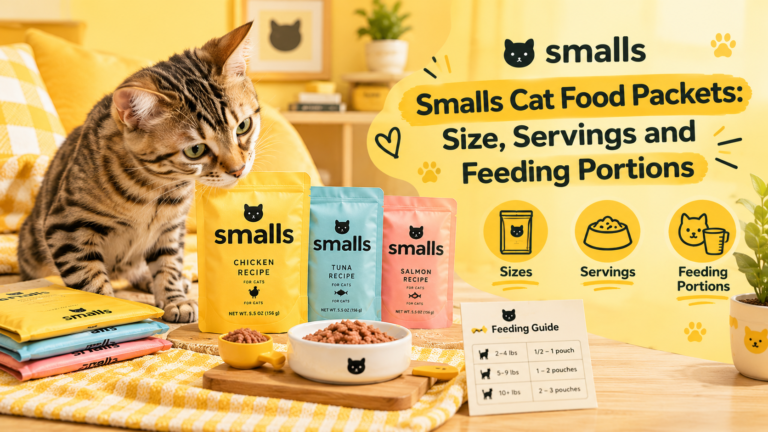
If you’re considering Smalls, you may be wondering how big the food packets are, how many calories they contain, and how many meals you can get from each packet. Understanding these details can help you plan your cat’s meals, organize your freezer, and estimate how much food you’ll need.
Smalls fresh-food packets generally contain 200 calories per packet, but the weight varies by recipe. Your cat’s daily portion depends on calorie requirements, body weight, activity, age, and other food they eat.
This guide explains Smalls Cat Food packet sizes, serving estimates, feeding guidelines, and how to calculate your weekly supply.
How Big Are Smalls Cat Food Packets?
Smalls fresh-food packets are individually packaged portions designed to make storing and serving food more convenient. However, not every recipe weighs exactly the same amount.
Smalls’ published nutritional information lists examples such as:
| Fresh-food recipe format | Approximate packet weight | Calories per packet |
| Several chicken and turkey recipes | 5 oz | 200 |
| Some fish and pork recipes | 5.5 oz | 200 |
| Some beef recipes | 4.1 oz | 200 |
These examples show why it’s important to check the nutritional information for the specific recipe you’re buying. Different recipes can provide the same stated calories in different packet weights.
Also, don’t assume fresh food, freeze-dried food, treats, and broth all use the same packaging or serving measurements. Each product has its own instructions.
How Many Servings Are in Smalls Cat Food?
The number of servings in a Smalls packet depends on your cat’s daily feeding needs and how you divide its food.
A fresh-food packet containing 200 calories may provide a full day’s food for some adult cats. Other cats may need more than one packet daily, while some may need less.
You can also divide a daily portion into two or more meals. For example, if your cat’s feeding plan calls for one packet per day, you could divide that amount between breakfast and dinner.
Keep these distinctions in mind:
- Packet: The packaged amount of food.
- Daily portion: The total food your cat needs in a day.
- Meal serving: The amount offered at one feeding.
One packet does not automatically equal one meal. The correct amount depends on your cat’s individual needs and the product’s calorie content.
How Many Smalls Packets Should You Feed Your Cat?
Smalls publishes starting guidelines for adult cats based on their goal weight. For its fresh frozen food, the brand provides the following approximate daily amounts:
| Cat’s goal weight | Approximate fresh-food amount per day |
| 4 lb | 0.4 packet |
| 6 lb | ⅔ packet |
| 8 lb | 1 packet |
| 10 lb | 1 packet |
| 12 lb | 1¼ packets |
| 14 lb | 1½ packets |
These figures are Smalls’ published guidelines, not a personalized diet plan. They assume an adult cat at its goal weight and may not suit every cat.
Your cat’s calorie needs can vary based on age, activity, body condition, health, and any additional food or treats. Kittens, pregnant or nursing cats, and cats that need to gain or lose weight may require different amounts.
If your cat has a medical condition or needs a weight-management plan, consult your veterinarian before changing its feeding amount.
How Many Calories Are in a Smalls Cat Food Packet?
Smalls’ published feeding guide identifies a typical fresh-food packet as containing 200 calories.
Calories are important because packet weight alone doesn’t tell you how much energy the food provides. Two packets can have different weights but the same stated calorie content.
When estimating your cat’s daily food intake:
- Check the calorie information for the exact recipe.
- Review the brand’s feeding guide.
- Consider all the food and treats your cat consumes.
- Monitor your cat’s weight and body condition.
- Ask your veterinarian if you need an individualized calorie target.
Use the calorie information on the current product packaging whenever possible, particularly if you’re comparing different recipes or product formats.
Can You Split a Smalls Cat Food Packet Between Meals?
Yes. Smalls says its daily fresh-food amount can be divided into two or more meals.
Splitting the daily portion may be convenient if your cat prefers smaller meals or follows a regular morning-and-evening feeding schedule.
To portion a packet:
- Determine your cat’s approximate daily amount using the appropriate feeding guidance.
- Decide how much to serve at each meal.
- Place the unused portion in a sealed container or bag.
- Return it to the refrigerator promptly.
- Follow the manufacturer’s storage instructions before serving the remaining food.
Smalls states that thawed fresh food can last up to five days in a sealed container or bag in the refrigerator. Keep it at or below 40°F and follow the guidance for your specific product.
How to Calculate How Many Smalls Packets You Need
You can estimate your weekly supply by multiplying your cat’s daily packet amount by the number of days you want to plan for.
Formula:
Daily packet amount × Number of days = Estimated packets needed
Here are two simple examples:
| Daily feeding amount | Days planned | Estimated amount needed |
| 1 packet | 7 days | 7 packets |
| ½ packet | 7 days | 3.5 packets |
| 1¼ packets | 7 days | 8.75 packets |
These are arithmetic examples, not recommendations for how much your cat should eat. Use your cat’s actual feeding plan to calculate the amount.
If your cat eats half a packet daily, for example, seven days would require 3.5 packets. Your delivery schedule, recipe selection, and any other foods you provide will affect how much you need to keep on hand.
You should also allow for the time needed to thaw frozen packets in the refrigerator. Smalls recommends moving a packet to the refrigerator about 24 hours before mealtime.
How Should You Store Unused Smalls Cat Food?
Correct storage matters when you’re using only part of a packet.
The Smalls cat Food recommends keeping unopened fresh-food packets in the freezer until you’re ready to thaw them. Move the next packet to the refrigerator ahead of time, and keep thawing food on an interior shelf at or below 40°F.
After opening a packet:
- Seal unused food in a suitable container or bag.
- Refrigerate it promptly.
- Follow the manufacturer’s recommended storage period.
- Avoid leaving perishable food at room temperature for extended periods.
- Check the product instructions if you’re unsure whether the food has been stored safely.
Are All Smalls Products the Same Size?
No. Smalls offers different product formats, including fresh food and freeze-dried food, and these shouldn’t be measured in the same way.
Fresh food is commonly portioned in packets with calorie and weight information. Freeze-dried food may have different package weights and feeding measurements, such as cups per day.
Treats and broth also have their own serving guidance. Check the label for the exact product rather than applying fresh-food packet calculations to every item in the Smalls range.
If you’re comparing products, consider the package size, calorie content, recommended serving, and storage requirements together.
Frequently Asked Questions
Is one Smalls packet enough for a whole day?
It may be enough for some adult cats. Smalls’ fresh-food guide uses approximately one 200-calorie packet per day for an average 10-pound adult cat at its goal weight. Individual calorie requirements vary, so use the feeding guide as a starting point.
How many calories are in one Smalls packet?
Smalls identifies a typical fresh-food packet as containing 200 calories. Check the nutritional information for your exact recipe and product.
Can a smaller cat eat half a packet?
Some cats need less than a full packet each day, but the right amount depends on their calorie requirements. Follow the feeding guide for your specific product and consult a veterinarian if you’re unsure.
Can I divide one packet into two meals?
Yes. Smalls says the daily fresh-food amount can be split into two or more meals. Store unused food according to the product’s refrigeration instructions.
Are all Smalls fresh-food packets 5 ounces?
No. Published nutritional information lists some recipes at 5 oz, others at 5.5 oz, and some at different weights. Check the current label for the specific recipe.
How many packets do I need for a week?
Multiply your cat’s daily packet amount by seven. For example, a plan of one packet per day requires seven packets for seven days. This calculation estimates supply only; it doesn’t determine the right feeding amount for your cat.
Should I feed my cat based only on packet count?
No. Packet count is a convenient way to measure food, but calorie intake, age, activity, body condition, health, and treats also matter. Ask your veterinarian for a personalized feeding plan if your cat’s needs are uncertain.
Final Thoughts
Smalls Cat Food packet size and serving amounts can help you plan meals, but the right daily portion depends on your cat and the recipe you choose.
Check the packet’s weight and calorie information, use Smalls’ feeding guide as a starting point, and divide the daily amount into meals that suit your routine. When estimating weekly supplies, calculate from your cat’s actual feeding plan rather than assuming every cat needs the same number of packets.
Proper thawing and storage also help make feeding more convenient. With a consistent routine, you can plan your food supply while keeping your cat’s individual needs in mind.